5. Subcultures in China: An analysis of «ziganwu’s» and «Shamate’s».
Regarding the subject of subcultures, I tried to know what types of subcultures are present in China and how «particular» they are. Thus, I began to search about this and found two quite particular subcultures that I will talk about below: The Shamates and the Ziganwu.
With respect to The Shamates, these are considered for the Chinese and foreign people that one of the most hated subcultures in China. This, for due to their way of dressing, where a rather extroverted glam-gothic-anima-kei fashion style predominates (and quite «controversial» ,considering the Chinese «rigidity» ); for its «selfless» and «aggressive» attitude about education, good customs and privileged training of young Chinese people (something crucial for the development of the country, according to the Chinese government), of which they consider themselves strong opponents; and because they are considered by the other people of the China, in a way, a «shame» for his country.
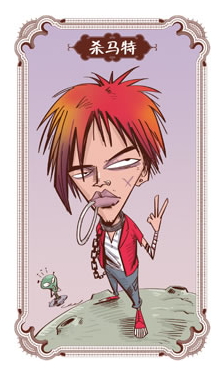
For another part, and with regard to the Zeganwu, these could be defined as Chinese volunteers who are dedicated to promoting, through social networks, the ideals of the Chinese communist goverment, of which they are faithful defenders. Also called «internet commentators», they are a subculture that stands out for its extreme patriotism, its thoughts, behaviors and attitudes in favor of communism in China and for its constant «cyber conflicts» with the Chinese liberals and pseudo liberals, who openly criticize the Chinese communist government on the Internet and/or the policy used in China today.

References:
BuzzFeedNews (2013). Meet Shamate, China’s Most Hated Subculture. Taked from: https://www.buzzfeednews.com/article/kevintang/meet-shamate-chinas-most-hated-subculture.
Global Voices advox (2015). Local Chinese Authorities Use Internet Slang ‘Ziganwu’ in Their Propaganda Recruitment. Taked from: https://advox.globalvoices.org/2015/06/15/local-chinese-authorities-use-internet-slang-ziganwu-in-their-propaganda-recruitment/#.
Reference Images taken from: http://spanish.china.org.cn/txt/2013-12/31/content_31054153.htm
4. Types of cultures according to Hofstede: similarities and differences between China and colombia.
Continuing with the theme of the previous post, I wanted to investigate more about the similarities / differences between China and Colombia, but this time not from the Lewis model, but from a more detailed model about the types of culture that exist and their characteristics: The Hofstede model. And so, this was what I found: 
Undoubtedly, the similarity of both countries in Power distance, Individualism and Masculinity draws attention, making it clear that both countries tend to accept social inequality (although while in China it is due to the type of government, while here perhaps is one more issue of mentality), both are usually predominantly collective societies (perhaps due to the unequality they perceive and the need to help each other to face it) and both tend to give some preference to success and achievements.
However, what most attracts attention, and is likely to be some of the many reasons why China is a world power and Colombia is still a developing country, are the differences that exist in both countries with respect to Uncertainty Avoidance, Long Term Orientation and Indulgence. In this form, while China is a country open to new ideas (something necessary for development), Colombia is still very conservative country about it; While China bets on development and education (also necessary for a society to advance), Colombia still seems to live in the last century; and, while China is usually strict with its rules and laws (something very useful for everyone in the country to move towards the same direction) Colombia has the dubious honor of being one of the most corrupt countries in the world.
Thus, the main conclusion I can reach is that, despite the problems regarding stereotypes and the role of women in society in China (mentioned in previous posts) and based the fact that each culture is different, I can To say that we have much to learn from countries like China to be able to move forward as a society, as human beings and achieve, in this way, a better future, of which we are all part.
3. Types of cultures according to Lewis and his impact: A comparison between China and colombia.
Today we will talk about the types of culture raised by Lewis and how they can «crash» between they, affecting the well-being of people envolved in this at different scales.
For starters, China, the country to which this blog is dedicated, is a country that fits 90% in what Lewis calls reactive culture. In this way, one could say that the people of China are very good at listening, they rarely initiate an action or discussion, they tend to be introverted people, they tend to be very respectful of the speech of others and often use their nonverbal language.
In the other hand, in Colombia, my country of origin, predominates what Lewis called multiactive cultures. So, in this side of the world people are usually talkative, impulsive, very expressive and quite hospitable to others. Likewise, the people usually do many things at the same time, and do not depend on super strict agendas or defined schedules.
With this clear, I have the doubt of what would happen if someone from China came to Colombia? What problem would face? Would it adapt or would it feel wrong?
To answer these questions we can based on the model proposed by Lewis. In this way, the first difficulty that this person would encounter in this culture would be the issue of closeness to others. A person accustomed to being introverted and respecting the space of others, would undoubtedly feel harassed to see not only that people on this side of the world are excessively «close», but that it is something completely normal.
Similarly, the relaxed attitude of the people of the multi-active culture and their tendencies to be impulsives, could become too much for a person from China can accept it.
2. Gender stereotypes in China: a comparison with Latin American countries.
Thinking about the gender stereotypes present in the Chinese culture, I thinked 3 questions about the topic I want to share with you (and incidentally, try to answer):
- Do women in China have the same rights as men?
- Are there gender stereotypes in China as marked as there are in Latin America?
- Is there any kind of regulation in China that acts on the issue of gender stereotypes?
With respect to these questions, there is one certain thing: China is worse than Latin America (especially Colombia) in terms of gender stereotypes. In fact, and with respect to China, this is one of the countries with the greatest gender stereotypes in the world, which are reflected in terms of health, education, political power and economic opportunities. In fact, and comparing it with Colombia (one of the most unequal countries in Latin America), it is incredible that the scenario here is «a little better», as women have a relatively greater freedom of social expression.
Its so marked the gender stereotyping in China, that women, despite having access to higher education equal to men, can only perform professions «own the women», as manicurist, decorator, secretary, etc. This in Colombia (and in Latin America in general) is not seen as much, since although the idea that exist «work exclusive» for women are also present, the women’s are more free to choose their professional career.
However, and compared to our country (Colombia) , this issue of stereotypes is more reflected in China by the condescension of the Chinese government regarding this. While in Colombia there are laws, campaigns and initiatives to break these gender stereotypes (although in some cases they are not so useful), in China the laws, the academy and even the same society, reinforce these stereotypes. This may be due in part to the conservative thinking of the Chinese Communist state (the main dominator of the country) since, despite of China’s exponential development both technologically and socially in recent years, this country still has many rural areas where quite a thought predominates rigid and stereotyped.
In conclusion, I think it is a sad thing, as despite China is a country that has achieved big development lately, still present these problems of gender stereotypes. However, I believe that there is hope, since more and more women are the ones that stand out within this technological and social development in China, and I hope, from the bottom of my heart, that in a few years these stereotypes will practically disappear (the same in our country, although unfortunately we don’t have the development of China).
1. Stereotypes about Chinese people: The stereotype of the Chinese appearance.
In this post, I will tell you about a fairly frequent stereotype about Chinese people. This stereotype is the physical stereotype. On this side of the world (Colombia, South America) it is often believed that Chinese people are short, thin, weak physical, yellow skinned, that all are equal and, in particular the mens, quite effeminate traits. (also other stereotypes about gastronomic customs or his «negative» actitude with the foreigns, topic of other future post). A clear exampleof this can see in the next image.

However, you only need to do a brief search on Google to realize that not all Chinese people are equal, do not have yellow skin and that the vast majority of Chinese men do not have feminine features. For this reason, I want take advantage of this blog post to try to clarify, of a simple manner, one of the main stereotypes about Chinese people: The stereotype of its appearance.
Some things about the Chinese culture.
Today I will talk about 4 main elements of Chinese culture: Language, Music, Norms and Religious beliefs.
About the language, in China the official language is Mandarin, spoken by more than 800 million native inhabitants. However, it is not the only language in the country. Currently, there are 292 types languages in this country, distributed in 56 recognized ethnic groups, that in turn, are part of 9 different traditional families.
- The Sino-Tibetan family.
- The Tai–Kadai family.
- The Hmong–Mien family.
- The Austroasiatic family.
- The Turkic family.
- The Mongolic family.
- The Tungusic family.
- The Koreanic family.
- The Indo-European family.
About CHINESE MUSIC, this can be divided into 3 sub-types:
- Traditional music, composed of instrumental music; ethnic music (a type of heterophonic music, in which musicians play versions of the same melodic line) and the Chinese opera.
- Regional music, typical of ethnic groups residing in particular areas of the country.
- Modern music, in which highlights popular music (especially in c-pop or Chinese pop) and rock n ‘roll.
In terms of RELIGIONS, the predominant religions of China are Buddhism, Taoism, Confucianism and the traditional Chinese religion. However, a large majority of the population does not identify with any religion, being agnostics, atheists or just spiritual people not attached to any religion. In percentages, the situation is:
- 73,56% Non religious or Chinese folk religion.
- 15,87% Buddhism.
- 7,60% Other religions.
- 2,53% Christianity.
- 0,45% Islam.
For end, THE NORMS of China is characterized as a have extrict protocols.. In some of the situations in which we can highlight his way of proceeding in society is when the people interacting with strangers and eating. Some examples of this are:
- It is mandatory to greet the head, and in some cases a handshake.
- Kisses and hugs are not allowed.
- Punctuality and dress is extremely important for the oriental culture.
- Turning your back is a very serious offense, so when you say goodbye, take the first steps back and then turn around.
- You should not start the meal without the host.
- It is usual to make noises at lunchtime, this indicates the taste for what you are eating
In conclusion, this small “mouth opener” of Chinese culture allows us to know a little more about this wonderful country, its culture, its customs and what can be expected from the future of this, something crucial if you consider the development of This country in both current and future.
Sources:
https://en.wikipedia.org/wiki/China
Sigue mi blog
Recibe nuevo contenido directamente en tu bandeja de entrada.

